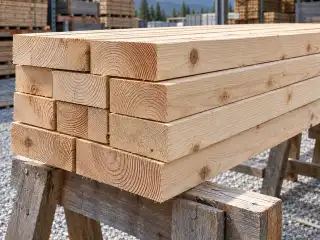
Board foot calculator
A board foot is the volume of a board 1 in thick, 12 in wide and 1 ft long. Using entered dimensions of 2 × 6 in and 8 ft, one piece contains 8 board feet. Match the supplier’s measurement basis before pricing the order.
How do I measure lumber for board feet?
- Confirm how the yard sells the stock: by piece, linear foot, board foot or another tally. Ask whether thickness and width for billing are nominal, rough or finished dimensions. Physical measurements and invoiced dimensions are not always interchangeable.
- Enter thickness and width in inches and length in feet. For rough hardwood marked in quarters, translate that thickness designation into inches before entering it; do not type a quarter designation as a decimal length.
- Count whole pieces with the same dimensions. Save separate lines for other sizes so differences in species, grade, moisture condition and price do not disappear inside an average board size.
- Review the cut list and available stock lengths before buying. Board-foot volume alone cannot show whether the required parts fit around knots, checks or other defects, or whether offcuts can be reused.
How is the quantity calculated?
Board feet = thickness (in) × width (in) × length (ft) × pieces ÷ 12
- Use inches for thickness and width, and feet for length. An all-inch formula instead divides by 144.
- Enter a whole number of pieces. Group boards with the same dimensions; calculate other sizes as separate lines.
- The tool rounds displayed board feet to two decimals. A supplier or grading program may use a different tally rule, so compare the same measurement and rounding basis.
Example: ten 2 × 6 boards, each 8 ft long
The entered 2 × 6 in dimensions are the selected calculation basis. This example does not claim that a surfaced 2 × 6 physically measures 2 × 6 in.
- Thickness: 2 in; width: 6 in; length: 8 ft.
- Quantity: 10 whole pieces; no price or hidden waste allowance.
- Multiply the mixed-unit dimensions: 2 × 6 × 8.
- Divide by 12 to obtain 8 board feet per piece.
- Multiply the unrounded per-piece volume by 10 pieces for 80 board feet.
- Multiply that total by a quoted price per board foot only when the quote uses the same tally basis.
80 board feet in the ten entered pieces; usable cut yield is a separate question.
How many board feet are in common entered sizes?
| Entered cross section | Length | Pieces | Board feet |
|---|---|---|---|
| 1 × 6 in | 8 ft | 1 | 4 |
| 2 × 4 in | 8 ft | 1 | 5.33 |
| 2 × 6 in | 8 ft | 1 | 8 |
| 2 × 8 in | 10 ft | 1 | 13.33 |
| 2 × 10 in | 12 ft | 1 | 20 |
| 2 × 12 in | 16 ft | 1 | 32 |
What is a board foot of lumber?
It is a volume unit, not a specific board shape. A piece that is thicker and narrower can contain the same board feet as a thinner, wider piece. The formula combines the cross-sectional dimensions with length, then converts that volume into board feet.
That does not make differently shaped pieces interchangeable for your project. A tabletop, shelf or framing cut list still needs suitable widths, lengths and thicknesses. Use the board-foot result to compare volume and material price, then check that the actual boards provide the required usable parts.
Why do I divide by 12 instead of 144?
The divisor depends on the units in the numerator. This calculator uses thickness and width in inches but length in feet, so it divides by 12. If all three measurements are in inches, divide their product by 144 instead. Both methods describe the same volume when the unit conversion is done consistently.
A frequent error is entering an inch length into a field labeled feet. Another is treating 8 ft 6 in as 8.6 ft rather than converting the six inches. Check the unit labels and the drawing before multiplying a per-piece result by the full piece count.
Should I use nominal or actual dimensions for board feet?
Use the basis that answers your question. To estimate physical volume, use actual measured dimensions. To check a supplier’s board-foot quote, use the dimensions and tally convention that supplier prices by. Do not silently compare a nominal-size invoice with a calculation made from smaller surfaced dimensions.
The AHEC measurement guide distinguishes rough thickness designations from surfaced stock. The Alaska lumber program also specifies a nominal-size tally within its own scope. Those references do not establish one universal billing rule for every yard, species or transaction. Ask for the quoted basis and preserve it with your saved line.
What do 4/4, 5/4 and 8/4 mean?
They are rough thickness designations expressed in quarter inches. In that system, 4/4 corresponds to one nominal inch, 5/4 to one and a quarter, and 8/4 to two. Enter the thickness in inches, rather than entering the characters of a stock designation into a decimal measurement field.
Surfacing removes material, so a rough thickness label does not guarantee an identical finished thickness. Check the stock description and the final thickness needed by your project. The calculator does not determine how much machining is possible or whether a particular rough board will clean up to the desired finished size.
Are board feet the same as linear feet or square feet?
No. Linear feet describe length, square feet describe area, and board feet describe volume. A linear-foot total cannot be converted to board feet without the width and thickness. Likewise, surface area does not tell you how much lumber volume is present until thickness is known.
Keep the pricing unit visible when comparing quotes. A price per piece for a fixed-size board is a different quote format from a price per board foot for random-width stock. Convert the quantity and price on the same dimensional basis; do not compare the numeric rates alone or assume the smaller number is cheaper.
Why can a supplier’s tally differ from the calculator?
Suppliers may use stated nominal dimensions, length conventions or per-board rounding rules. This calculator computes the group’s volume before rounding the total to two decimals; a displayed per-piece figure has already been rounded. Multiplying that displayed figure can therefore differ slightly from the displayed group total.
Check the quote’s tally convention before treating a small difference as an error. Also separate purchased volume from usable yield: defect removal, end trimming, saw kerfs and your cutting pattern can require more stock than the finished parts contain. There is no automatic waste percentage in this tool; enter the pieces you actually plan to purchase.
How do I estimate the material cost?
Enter the current quoted price per board foot using the same dimensional and tally basis. Save a separate estimate for each size or price group, then confirm milling, tax and delivery outside the material subtotal. The calculator supplies volume arithmetic rather than a lumber-price forecast.
Content updated . How we calculate. Source checks are listed below each reference.